
CARA A. BROWN, MBA • DESIGN STRATEGIST + SERVICE DESIGNER
CARA A. BROWN, MBA • DESIGN STRATEGIST + SERVICE DESIGNER
Mapping Success is a research methodology and decision-support system that converts scattered qualitative evidence into funder-credible impact proof. Built for EOYDC, deployed in a competitive grant cycle. The approach generalizes to any organization that knows it's creating value but can't yet demonstrate it in a way funders can act on.
Outcome: Supported securing the Propel Next $500K grant — one of the most competitive in the nonprofit sector. The CEO adopted the system as her primary tool in every grant meeting.
Live impact retrospective built to give nonprofit leaders and funders a single, executive-legible view of how youth outcomes create measurable, defensible value.
View interactive site →
Download the presentation →
Nonprofits routinely create real, profound outcomes — confidence, safety, mentorship, academic persistence, belonging. The work is legitimate. The impact is felt by real people. But when it's time to ask for funding, the proof system falls apart.
Stories and testimonials describe fragments. Dashboards capture activities, not value. Funders need to answer a specific question: what is the value of this change, and why is investing in it justifiable? Most nonprofits can't give them a clean answer — not because the impact isn't real, but because the system for demonstrating it doesn't exist.
The result is grant conversations that stay abstract and requests that are harder to substantiate. This is a systems problem, not a storytelling problem. Better slides don't fix it.
The methodology doesn't flatten human outcomes into numbers. It builds a pathway from lived experience to investment-justifiable value — and keeps both visible at once.
Primary research into real participant experience: what outcomes are people actually experiencing, described in their own words. This is the raw material funders can't get from dashboards — real human signal before it's been filtered through institutional messaging.
Synthesis that normalizes across different stakeholder perspectives, connects related signals, and surfaces the underlying impact categories. This is where "confidence" and "belonging" become evidence with structure — not just words people said.
The system map gives leaders and funders a single view: how inputs connect to outcomes, what the dependencies are, where the leverage points sit. The CEO's ability to walk a funder through this in real time — without slides, without prep — was the capability this step created.
A methodology that lives in a document is a deliverable, not a capability. The final step ensured the proof system could be picked up, presented, and defended by the CEO in a live grant meeting without requiring a designer in the room. That's the difference.
A visual representation of the full impact pathway — from what the organization does, to what participants experience, to what value those experiences create in the world. Not a logic model. A decision-support view that makes the theory of change explicit and surfaces assumptions rather than implying them.
Designed to be repeatable — so every new cohort, program, or year of data feeds into the same structure without requiring a new research engagement. This was the difference between a one-time deliverable and an ongoing capability the organization could own and maintain independently.
A public-facing interactive site where the impact map, themes, and participant evidence could be navigated in real time — by funders, board members, or partners. The CEO could open this in a grant meeting or while networking and walk through the impact story without a prepared deck or support staff present.

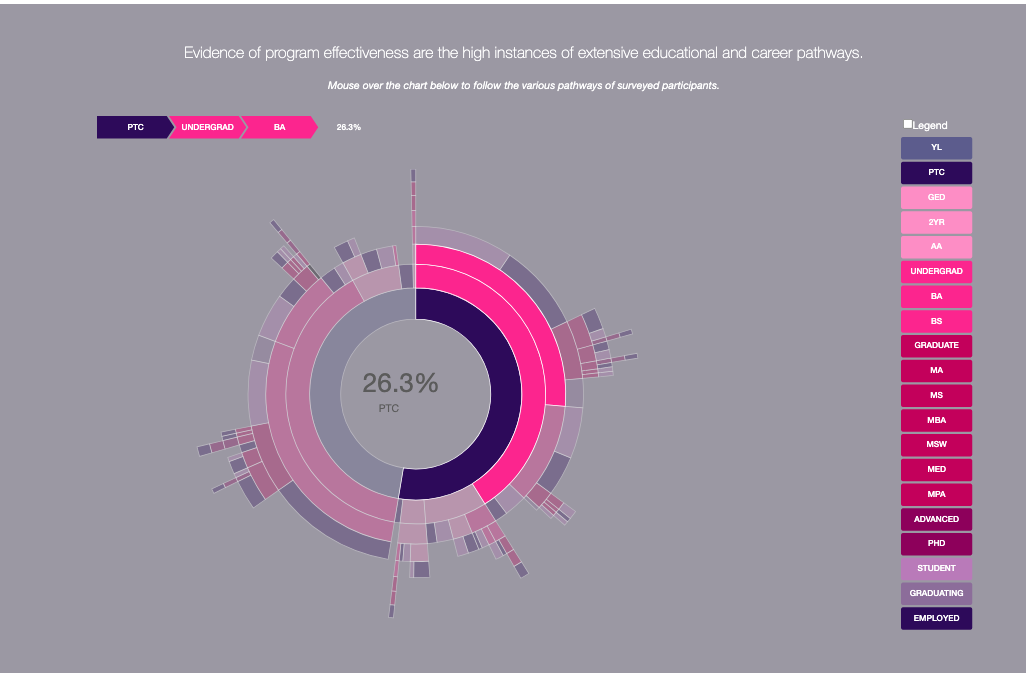
Highly competitive, awarded to organizations that can demonstrate clear, credible impact pathways. The system was the proof mechanism behind the ask.
The CEO adopted the system map and interactive site for every grant meeting — replacing ad hoc storytelling with a consistent, defensible, and reusable impact narrative. Used in every major grant conversation after it was built, including presenting it at her Ted Talk.
Overall funding increased after the proof system launched — not only from the Propel Next grant, but across subsequent conversations where the methodology was in use.
This is a valuation problem dressed as a communications problem. Most nonprofits try to fix it with better storytelling. The actual fix is a system — one that captures real signals, translates them into funder-legible structure, and puts that structure in the hands of a leader who can use it live.
How I Work →Mapping Success was built for EOYDC but the methodology applies anywhere qualitative outcomes need to become investment-justifiable evidence. If your organization delivers real human change and struggles to prove it in ways funders can act on, this is the kind of work that closes that gap.
Download case study →