


EOYDC needed more than a fundraising campaign. They needed a system that could run — and repeat — without starting over every year.
#CloseTheGap was built as an end-to-end individual giving architecture: strategy, brand, content, staff enablement, gamification, and channel orchestration — designed from the first day to be reusable.
Hit the $10K #GivingTuesday goal with matching — on a single day — as part of a broader campaign that funded 8 programs, served 500+ students, and supported $300K in Apple equipment purchases for Oakland youth with no computer or internet access at home.
EOYDC ran on grants. Individual giving wasn't a system — it was sporadic and unmeasured.
14,000 kids in Oakland lack access to computers or internet. 40% of Oakland Unified students have no device or connection at home. Castlemont High alone had 282 of 564 students without the basics. The need was documented, the organization was proven, and funding existed through grants — but individual giving was untapped.
There was no campaign name, no visual identity, no content system, no staff enablement, no peer-to-peer infrastructure, no donor recognition pathway, and no measurement framework. Every element had to be built before any giving could begin.
The overall fundraising goal was $50,000 — with a $5K/month recurring target as the structural objective, because recurring donors compound over time in a way that one-time gifts don't. The campaign needed to produce that infrastructure, not just the cheque.
Without a repeatable system, any success in year one would require a full rebuild in year two. The design goal wasn't just a successful campaign — it was an organization that knew how to run one.
A campaign raises money once. A system raises money every year — and gets easier each time.
Six interconnected layers — each one designed to work independently and reinforce the others.
Campaign identity & donor impact framing
Named the campaign, built the narrative architecture, and created the donor impact framing that translated EOYDC's work into language that moved people to give. The name was designed to anchor across channels — social, email, P2P pages, and in-person — while connecting directly to the digital equity problem it addressed.
Consistent cross-channel branding
Built a visual identity and content system that ran consistently across every touchpoint: social media posts, email signatures, fundraising pages, collateral, and partner materials. Every asset was templated for reuse — so staff didn't have to create from scratch each time they needed to activate their networks.
Ready-to-use toolkits & incentive structure
Designed and distributed toolkits for 12 staff fundraisers, 10 board fundraisers, and 3 partner fundraisers — with everything they needed to activate their personal networks without requiring help or improvisation. Incentive and recognition mechanics were built in from the start, not added as an afterthought. 100% staff participation was the result.
Multi platform P2P architecture
Built the peer-to-peer fundraising infrastructure on Network for Good — including 21 individual fundraising pages and the operational support to capture 47 manual donations that came in outside the platform. The P2P layer was what made staff and board activation measurable, not just encouraged.
Leaderboards, milestones & recognition pathways built into the cadence
Designed gamification mechanics — leaderboards, milestone markers, and donor recognition pathways — to sustain momentum across a multi-month campaign window. Gamification wasn't decoration; it was the mechanism that kept staff engaged after the launch energy faded and drove the recurring donor rate.
National campaign activation
Structured the #GivingTuesday activation as a distinct moment within the larger campaign — with its own goal ($10K + matching), messaging, and social media push — while keeping it connected to the broader #CloseTheGap narrative. National platform reach translated into local donor engagement, with new donors acquired through the giving day who then converted to recurring.
Visual identity, content system, and social proof — built for reuse across every channel.
Campaign identity: The #CloseTheGap name and visual system — designed to anchor across every channel and connect directly to the digital equity problem.

Primary creative: Campaign visual — tone, color, and framing calibrated to drive donor action while reflecting the real community impact.

Digital divide: 14,000 kids in Oakland lack access to computers or internet — a content post designed to make the gap impossible to ignore.
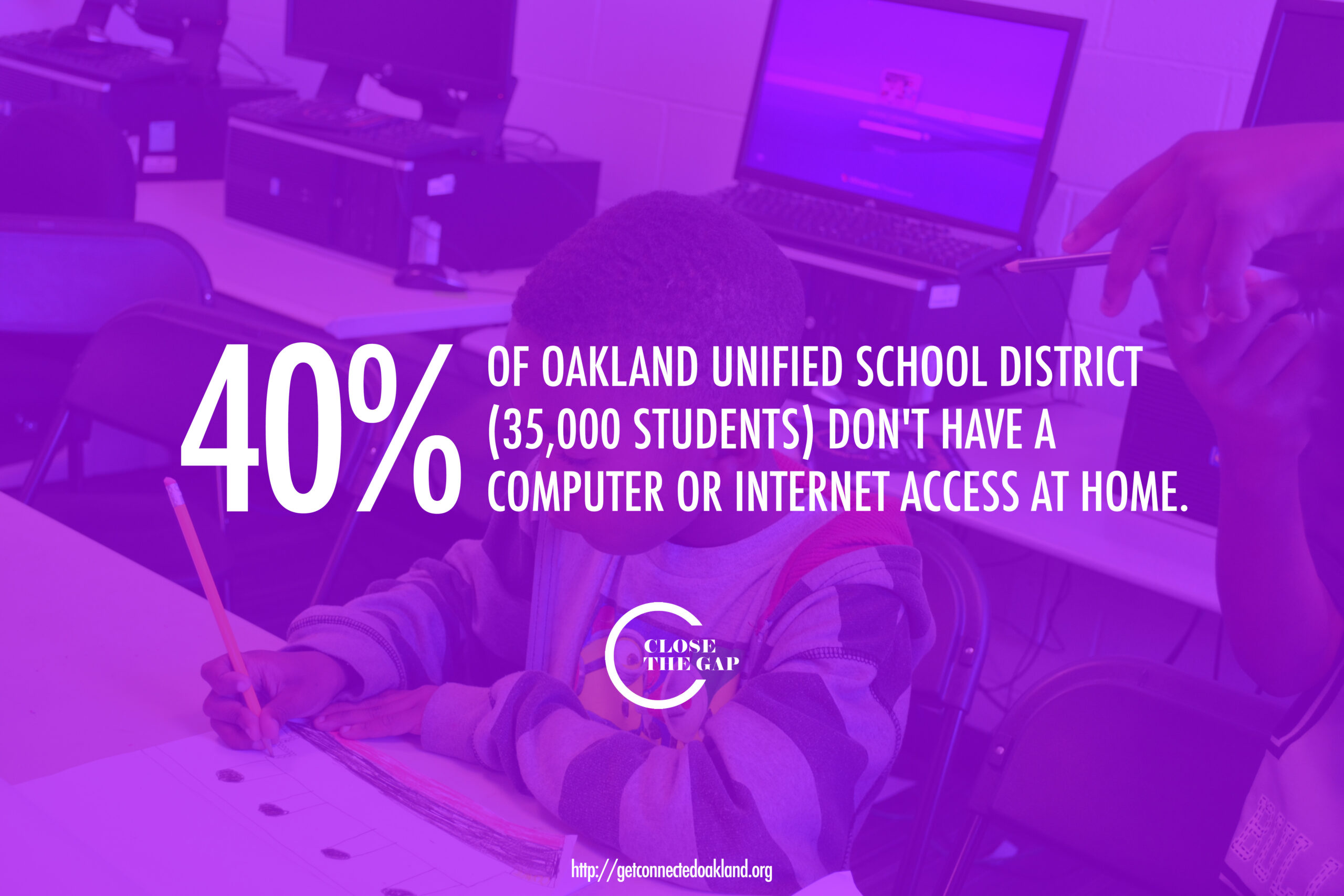
Impact stat: 40% of Oakland Unified students have no device or connection at home — framing the scale of the problem for donors unfamiliar with the district.
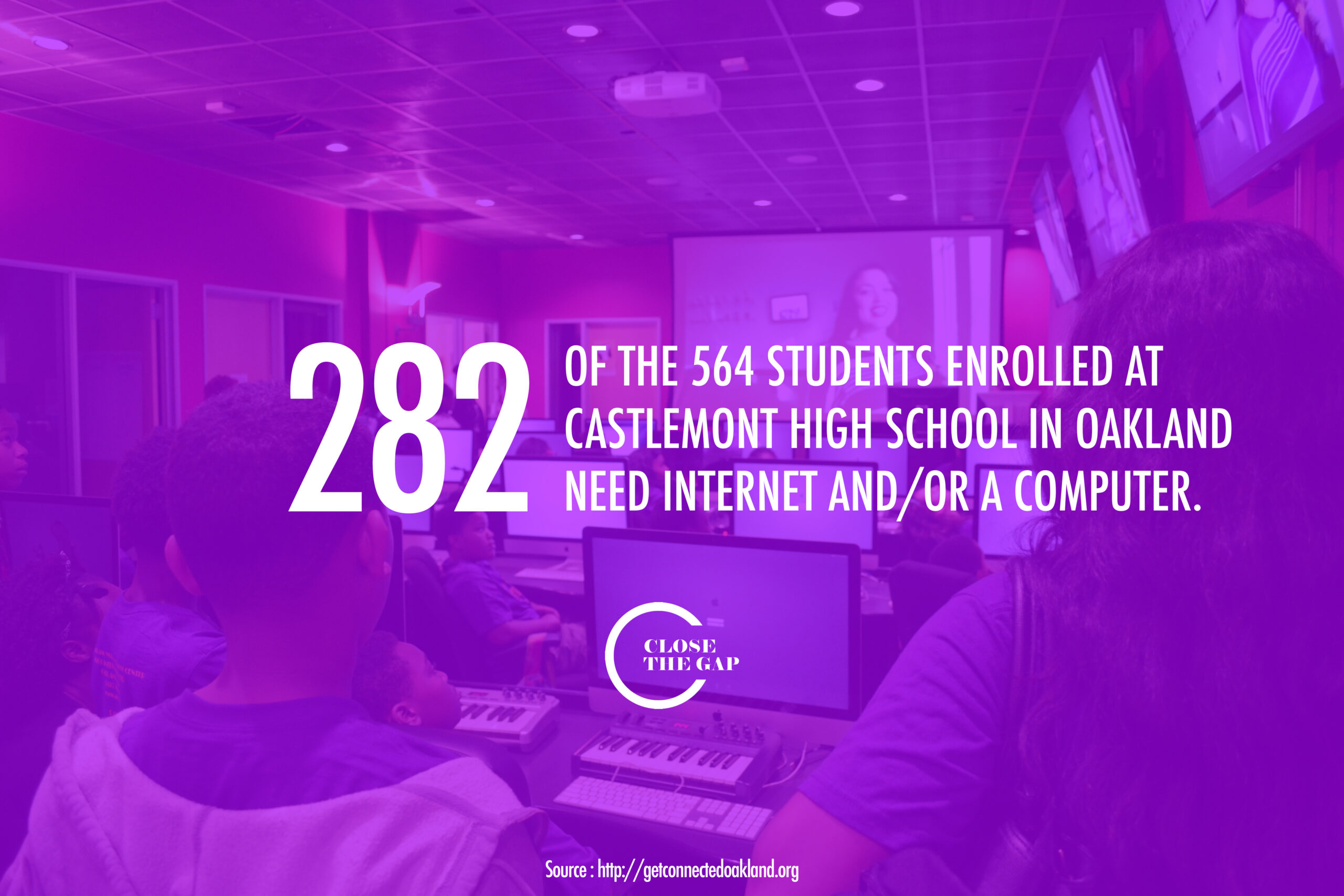
Hyperlocal data: Castlemont High — 282 of 564 students without the basics. School-specific numbers that made the problem personal, not abstract.
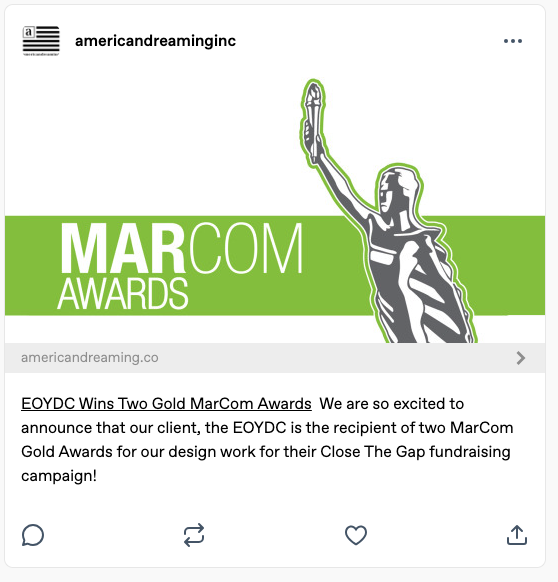
Campaign in action: The full system running — content, pages, and activation working together across channels during the giving window.
12 staff, 10 board, and 3 partner fundraisers — all equipped with toolkits and incentives. 21 fundraising pages created. 100% staff participation was not an accident; it was a design output.
Every donor acquired was new to EOYDC. Nearly two-thirds converted to recurring — the structural goal from day one, because recurring donors compound over time in ways one-time gifts don't.
EOYDC left with a reusable system: assets, cadence, channels, and enablement to support ongoing individual giving. Staff and board were equipped and activated. The organization knew how to run the campaign again.
Network for Good case studied this campaign as a benchmark of fundraising success
Network for Good — the platform used to run #CloseTheGap — studied the campaign's fundraising strategy and results as a model for nonprofit peer-to-peer giving. The peer-to-peer architecture, staff enablement approach, and donor conversion rate were cited as standout elements of the campaign design.
Read the article →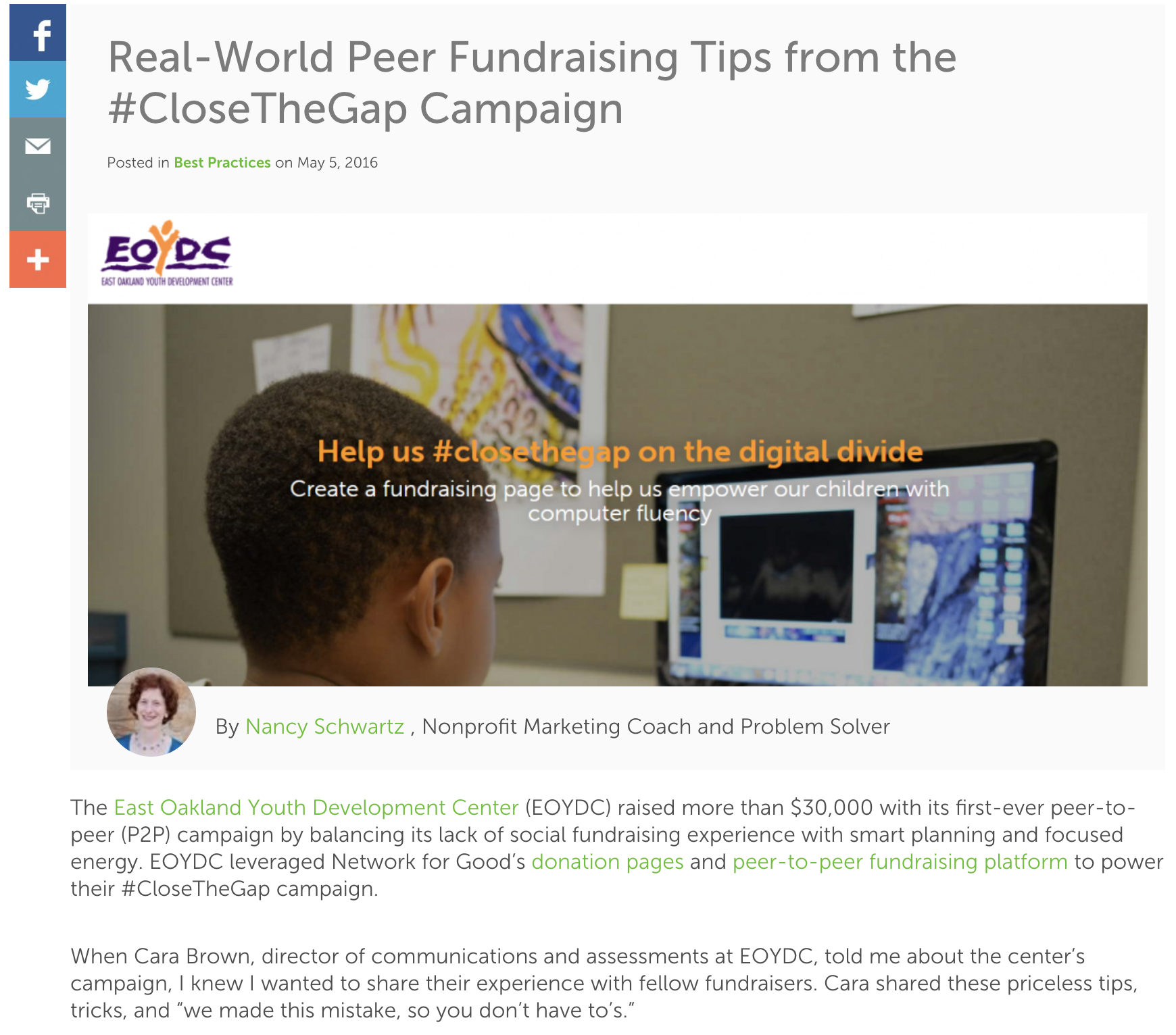
The gap between having a cause worth funding and having a system people can actually give through is a design problem. #CloseTheGap was built so the answer to "how do we run this again next year?" was already built into the first year.
How I Work →