
I diagnosed the financial exposure no one had quantified — and moved a three-year stall to enterprise rollout
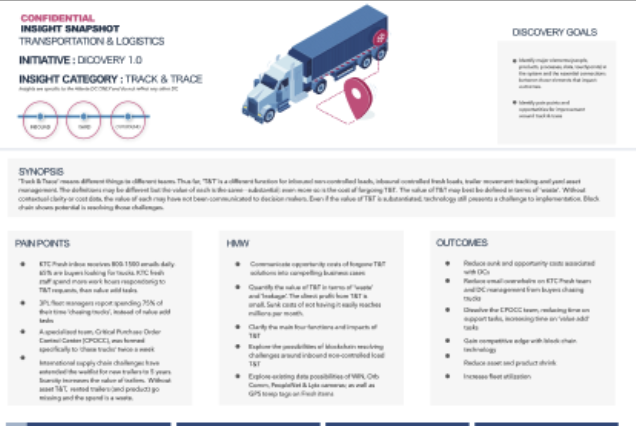
(Blurred - per legal parameters) This Insight Snapshot changed the annual plan — one page, clear financial framing. The VP read it and imediately redirected the entire strategy conversation, and made it the strategy focal point.
Estimated enterprise-wide loss per week across 34 DCs — calculated from $15M confirmed at a single site during one field visit.
$10.5M in quantified benefits against $4.6M total system cost — the financial case that got three VPs to sign the charter.
The initiative had been dormant for three years. Once the financial framing landed, it moved from stalled to enterprise deployment in four months.
Transportation, Supply Chain Strategy, and Distribution Strategy — alignment that had eluded the project for years, secured after one reframe.
SVPs knew they had a big problem. They didn't know the origins — but knew the cost. My job was to discover that truth, translate it into financial language, and craft clear action steps for them to take with confidence toward a solid resolution. Thats what I did.
The Problem
A $270M-per-week exposure was hiding in plain sight across 34 distribution centers. Leadership knew something was wrong — but no one had translated operational reality into financial language. Without that translation, three years of initiative had gone nowhere.
The Solution
I led the ground-truth diagnostic, built the financial case from field evidence, and structured the alignment infrastructure that moved three VP signatures from stalled to chartered — in four months.
A strategy meeting with the Supply Chain VP collapsed mid-presentation. He stopped the room: "I don't know what you're talking about." I sent a one-page insight snapshot — $15M lost per week at one DC, managers spending more than half their day hunting trailers, product never recovered. He printed it out and read it in the room. "This is what we're going to focus on." Meeting over.
VP alignment securedLed field research across 5 distribution centers — replacing the product team's assumption-based model with on-the-ground evidence that became the foundation for every executive conversation that followed. This is the kind of truth no one volunteers in a meeting room.
Strategic foundation establishedDesigned the cross-functional artifact that translated field findings directly into product requirements — eliminating the translation gap between research and delivery, and accelerating the team's velocity with evidence they could defend to leadership.
Delivery velocity unlockedArchitected the program's operating infrastructure — a unified collaboration environment joining charter, research, and requirements into a single source of truth that enabled cross-functional teams to align, decide, and move from shared ground.
Single source of truthThe real problem is rarely the one presented. This is a Clarity architecture — where the critical work happens before any solution is scoped. When someone finally goes to the ground, reads what's actually happening, and translates it into financial language leadership can act on.
How I Work →